Know exactly which cards to open and when!

Your easy 3-year plan to earn
up to 1.3M travel points (or more!).

Ready to save thousands on travel with credit card points— but terrified of doing it wrong?

  • What card should you open first?
  • When should you open your next one… and your next one?
  • How many cards is too many to have?
  • Won’t all this tank your credit score?

I talk to people all the time who want to better use their travel points, but they’re too overwhelmed—or too nervous about hurting their credit score—to start. They tell me, “Katie, I just need someone to hold my hand and tell me exactly what to do and when to do it.”

That’s why I created this Three-Year Plan.

In it, you’ll see the exact card order and timing I would use if I were starting over today. Check off steps as you go, watch your points add up, and finish with up to 1.3 million points (or more!) to spend—on just about any kind of travel you can dream up. 

We love throwing in tons of detail—for free.
Here’s how we can provide it at no cost to you.

Everything I share—on the site, the podcast, and social media—is completely free for you. I know that can make people wonder if there’s a hidden catch or some kind of sales push. Here’s how it actually works: when you use my links to apply for a credit card, I may earn a commission. But I only share offers I truly think are the best available, even if I don’t earn anything from them (how else could you trust me?). Over time, it all balances out. So as long as you keep using those links when it makes sense for you, I can keep creating reliable content you can trust!

This is really important!

Don’t start applying for cards just yet.

Step #1

Read Travel Points 101.

It only takes about 20 minutes to read—and it will save you from headaches like hurting your credit score, paying unnecessary fees, or getting that dreaded “Sorry, your application was denied” email.

Step #2

Now you can start applying!

Next, dive into the plan that makes the most sense for you—one-person if you’re earning points solo or two-person if you have a partner in your household who’s joining in.

Step #3

Get help anytime you need it.

As you start working through your plan, hop into our free Facebook group. You’ll be part of a community of people following the same steps—so you can ask questions, get advice, and share wins as you go.

At this point, I’m going to assume you
have completed Travel Points 101—congrats!

Now it’s time to pick your plan.

One-Person Plan

You’re earning points on your own.

Two-Person Plan

You’re earning points with a partner.

Six months after finding this, we have almost half a million Chase Ultimate Rewards and have booked our first hotel redemption in Hawaii.

Katie takes the time to thoroughly explain things for those who are entirely new to this hobby. I would highly recommend it to anyone interested in getting into points and miles – and I have!

-Podcast reviewer

One-person earners,
you’re in the right place!

One-Person Plan

I’m about to walk you through a lot of information—but don’t worry.
We’ll go step by step so you can check off each one without feeling overwhelmed.
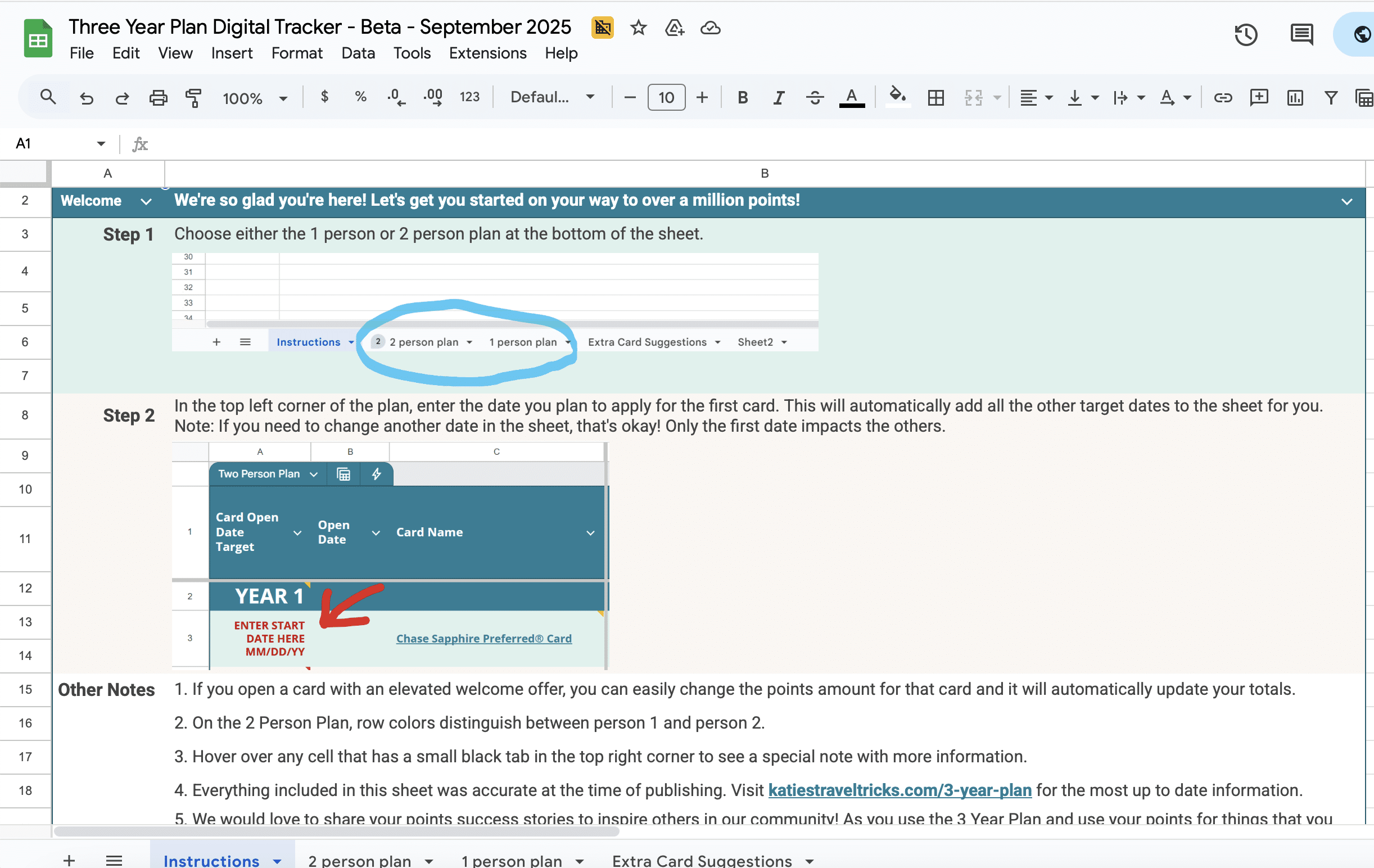
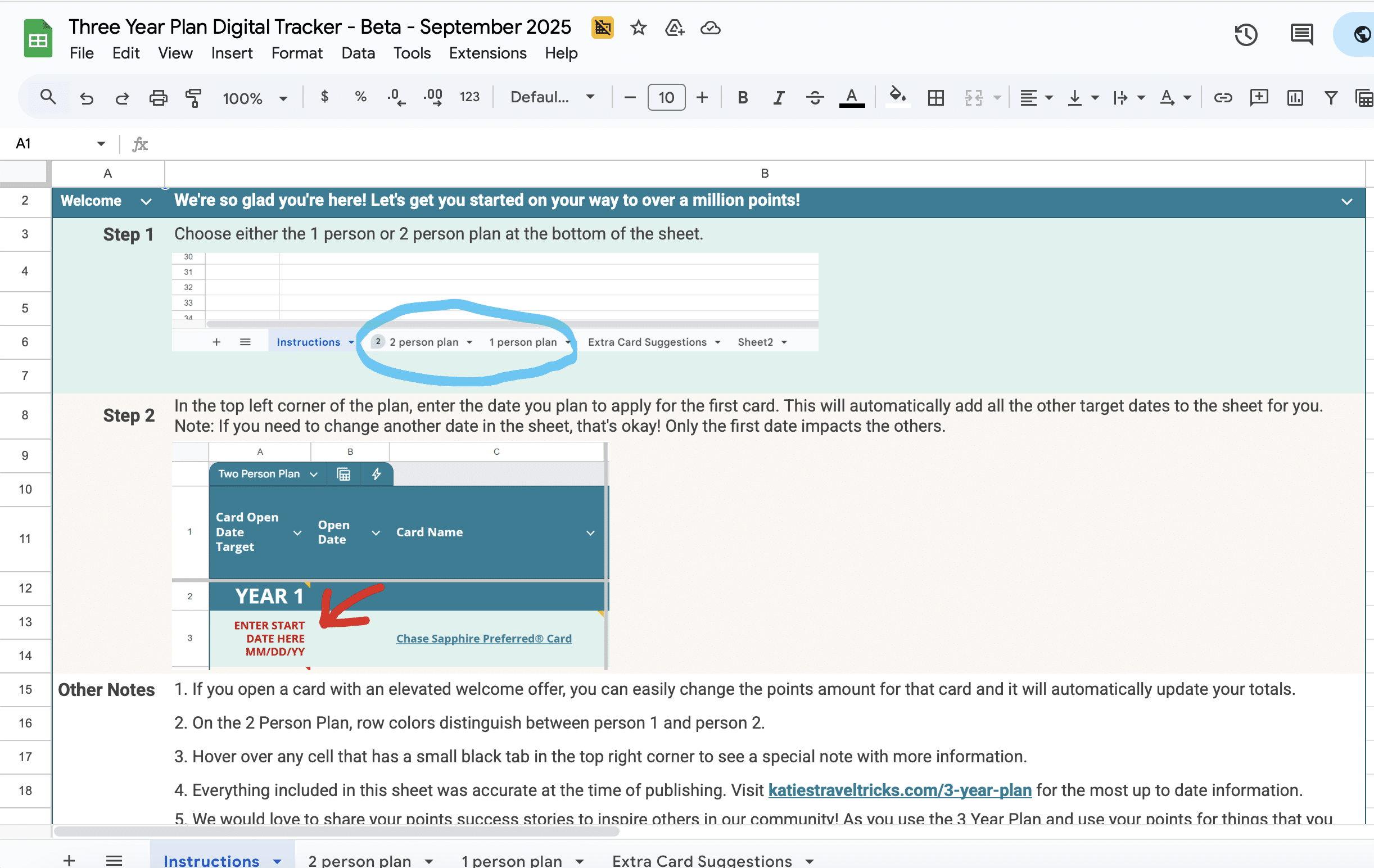
Drop your email below, and I’ll send you a digital tracker to chart your progress.

In three years, you’ll earn 1.1M+ points worth an estimated $16,000+ to use towards flights, hotels, and other travel perks.

Year One

327,000 points

Year Two

516,000 points

Year Three

324,000 points

These annual charts give you the mile-high overview.

We’ll dig into the details in the sections below—but anytime you’re ready, you can grab your free digital tracker to follow along.

Now, let’s fill in the what, the
why, and the how behind each step.

Year One

When you’re starting out, the hardest part is knowing where to begin. There are so many cards and rules, and it feels like if you pick the wrong one, you’ll mess everything up. That’s why Year 1 of this plan is all about keeping things simple, building confidence, and stacking a big pile of points right away.

By the end of Year 1, you’ll have over 327,000 points and miles spread across three programs:

  • Chase Ultimate Rewards® (these are the most flexible and easiest to use–also great for our favorite hotel redemptions via Hyatt)
  • Capital One Venture miles (great for easy redemptions but flexible with other options, too)
  • Airline miles from a card that fits your home airport and your goals (look for one with an elevated offer)

That’s enough to cover multiple plane tickets, hotel nights, or even an entire vacation for two. And you’ll do it without hurting your credit score or juggling more than you can handle. Use the expandable sections below to understand what to open and when, step by step.

Note: With little consequence, you can start this plan at any point in the year. To keep things simple, I’m assuming you’ll start January 1.

Want to move cards around? You can shift cards to catch an elevated offer. Keep these limits in mind:

  • Before any Chase business card, be at 2/24 or below if you’re a sole proprietor (see our Chase 3/24 rule article), and hold no more than two Chase business cards.
  • Moving a personal card earlier can push you past 2/24. For example, a personal card opened before your Ink Business Preferred® in January of Year 2 puts you at 3/24.

We begin with the Chase Sapphire Preferred®. This card is the best “starter” in the points world because it keeps everything in one easy-to-use program called Ultimate Rewards®. You’ll earn a big welcome bonus (worth at least $750, and usually much more when transferred to travel partners).

Why Chase first? Chase has some of the most valuable points, but they also have one of the strictest approval rules: if you’ve opened too many cards in the past two years, they won’t approve you. That’s why we grab this card early—before anything else gets in the way.

You’ll use this card for your everyday spending and start earning a flexible pile of Chase points. Later in the plan, we’ll add more Chase cards that can combine with these same points, making them even more powerful.

Learn How to Apply for Chase Sapphire Preferred® here (affiliate link)>>

Resources

Application Notes

  • Chase’s “5/24” rule applies—if you’ve opened five or more personal cards in the last 24 months, you won’t be approved. This is why it’s important to start here.
  • As of June 23, 2025, Chase changed how points are valued through Chase Travel (usually worth less, sometimes more). Points are still easy to redeem and transfer to partners like Hyatt.
  • Extra perk: through December 31, 2027, you’ll also get $10/month in DoorDash credits (non-restaurant purchases).

Alternate Card Option

  • Chase Sapphire Reserve®: Includes more perks like airport lounge access. Most people will get some lounge access anyway with Card #2 (Venture X), but if your home airport has a Sapphire Lounge, this might be worth it. You can also start with Preferred and upgrade later.

Next, we’ll branch out a little and add the Capital One Venture X. Why now? Capital One can be picky about approvals if you’ve opened a lot of cards recently, so we want to lock this in early.

This card comes with premium travel perks that make your life easier right away:

  • Global Entry or TSA PreCheck credit (skip the long lines at the airport)
  • Airport lounge access (a comfortable spot to relax before your flight)
  • Cell phone protection if you pay your bill with the card

It also earns flexible miles you can use toward almost any kind of travel. Think of it as a card that levels up your travel experience while adding a big chunk of miles to your balance.

Learn How to Apply for Capital One Venture X here >>

Resources


Application Notes

  • Capital One is finicky about approvals. Generally, the more recent accounts/inquiries you have, the harder it is to get approved.
  • Some people report better approval odds by checking the box that says “I plan to carry a balance” (you should never actually carry a balance — it’s non-binding, but signals profitability to Capital One).
  • Strong long-term value: $300 annual travel credit + 10,000 bonus miles each year on your anniversary.

Alternate Card Option

  • Capital One Venture: Lower annual fee, still earns Venture miles. A good alternative if you already have lounge access through another card or don’t care about lounge access.

Don’t get scared by the word “business.” Almost everyone qualifies for a business card in the bank’s eyes. Selling items online, freelancing, tutoring, babysitting, dog walking—any side income counts.

The Chase Ink Business Unlimited® is one of the easiest ways to boost your points total. Here’s why it’s special: business cards don’t show up on your personal credit report, so they don’t make it harder to get approved for other cards later. You get the points without “using up a spot” in your 5/24 count.

The welcome bonus often shows up as “$750 cash back,” but here’s the trick: when you pair this card with your Sapphire Preferred, those points turn into Chase Ultimate Rewards® you can transfer to airlines and hotels. That makes them far more valuable than just cash back.

Learn How to Apply for Chase Ink Business Unlimited® here (affiliate link) >>

Resources

Application Notes

  • We have a full video walkthrough for first-time business card applicants.
  • People in our Facebook group have reported approvals with side hustles as small as $50/year in sales.
  • You’ll want to be at 2/24 or below if you’re a sole proprietor (see our Chase 3/24 rule article).

Alternate Card Options

We’ll round out Year 1 by adding an airline-specific stash of miles with an airline card of your choice. Two things to look for: an elevated welcome offer, and a business card from a bank other than Chase. It won’t add to your x/24 count or to the Chase business cards you hold, which keeps Chase approvals easier later. Check our Best Offers page for current airline card offers.

Airline miles are less flexible than Chase or Capital One points, but they are still valuable when you want to book flights directly. A single card bonus can often cover a full round-trip ticket internationally or 2 domestic round-trips. This step gives you options beyond Chase and Capital One, so you aren’t locked into just one way of booking.

By the end of the year, you’ll have three strong buckets of points to work with, giving you flexibility for flights, hotels, and upgrades.

At the end of Year 1, you’ll be sitting on over 300,000 points and miles. That’s enough for:

  • Multiple domestic round-trip flights
  • Several free hotel nights (Chase → Hyatt is a favorite strategy)
  • A premium travel experience with lounge access and TSA PreCheck/Global Entry already covered

Most importantly, you’ll have learned how to follow a clear plan without feeling overwhelmed. Every card has a reason, every step builds on the last, and you’ll end the year confident instead of confused.

Year Two

In Year 2 of the plan, you’ll keep earning Chase Ultimate Rewards®. We love these points for their flexibility and strong value. We just can’t get enough of them! You’ll also branch out into hotel-specific points and Citi ThankYou® Points.

By the end of Year 2, you’ll be set to earn about 516,000 points and miles spread across a few programs:

  • Over 100,000 Chase Ultimate Rewards® you can transfer to Hyatt, book travel via Chase Travel(sm), or transfer to airline partners
  • Enough hotel points with another program for a few nights
  • Citi ThankYou® Points, another flexible currency with more airline and hotel transfer partners

As much as we love Ultimate Rewards, you still need to pace yourself. It’s important to establish a good relationship with banks and avoid opening too many cards too quickly. We recommend never opening more than 4 cards with Chase in any rolling 12 month period, ideally fewer than 4.

This year has 5 cards in the plan because we’ve positioned the Citi Strata Elite® Card in December so you can take advantage of the triple dip strategy. That’s why the total for Year 2 is higher — we added the Strata Elite’s totals to Year 2 even though you technically earn them in Year 3.

You opened a Chase Ink Business Unlimited® Credit Card in Year 1, and now it’s time for your second Ink: the Chase Ink Business Preferred® Credit Card.

Remember: business cards don’t show up on your personal credit report, so they don’t make it harder to get approved for other cards later. You get the points without “using up a spot” in your 5/24 count.

Learn How to Apply for Chase Ink Business Preferred® here (Non-Affiliate link) >>

Resources

Application Notes

  • Katie has a full video walkthrough for first-time business card applicants.
  • People in Katie’s Facebook group have reported approvals with side hustles as small as $50/year in sales.
  • You’ll want to be at 2/24 or below if you’re a sole proprietor (see our Chase 3/24 rule article).

Alternate Card Options

  • It’s harder to get approved for multiple no-annual fee Inks as a sole proprietor.
  • If you have an LLC, you are more likely to be approved for another no-annual fee Ink like the Ink Business Cash®.
  • Premium option: Chase Sapphire Reserve® for Business
  • Prioritize whichever one has the best elevated offer when you apply.

A year ago, you kicked off this plan by opening a Chase Sapphire Preferred® Card. It’s a key piece of the strategy because it lets you convert the cash back from no-annual fee Ink cards or Freedom cards into Ultimate Rewards® points, which can then be transferred to Hyatt and other partners.

Now it’s time to decide what to do with your Sapphire card.

Your options:

  • Keep it if you regularly use the benefits and perks.
  • Keep it if you haven’t opened a Chase Ink Business Preferred® card.
  • Downgrade it if you did open a Chase Ink Business Preferred® card and want to minimize annual fees.

Downgrade details:
You’ll be able to downgrade to a Freedom card. Our recommendation is to request the Visa Freedom with Chase Ultimate Rewards® (sometimes called “Classic Freedom”). Though discontinued, it mimics the Freedom Flex® with rotating 5x categories each quarter (up to $1,500 spend). If you can max out those categories, it’s an excellent way to keep earning points.

Resources

Airline miles are less flexible than Chase or Capital One points, but they can be incredibly valuable when you want to book flights, and then you can save your flexible points for something else. A single card bonus might cover multiple round-trip tickets.

Like last time, pick a business airline card from a bank other than Chase. That keeps you at 2/24 or below and keeps your Chase business card count low for the Chase business card coming up in August.

American Airlines, Atmos Rewards, Delta–all of these can be good options depending on where you live and plan to travel to.

Check our Best Offers page for current airline card offers.

You’ll be evaluating the Ink card you opened in Year 1 (July, or whenever you started). It’s a good practice to do this with any card every year.

Before you make any changes to this card, make sure you’ve moved all your points to a Sapphire card and held the card at least 12 months. Then decide if it still earns its spot in your wallet.

One thing to keep in mind: next month you’ll apply for another Chase business card. Chase approvals are smoother when you hold no more than two Chase business cards when you apply.

Resources

Open a Chase business card of your choice. Before you apply, make sure you’re at 2/24 or below if you’re a sole proprietor, and that you hold no more than two Chase business cards.

The good news? There are a lot of options! Chase has business cards for IHG points, Hyatt points, United miles and Southwest points (Affiliate links). If you have a large spend coming up, look at Chase Sapphire Reserve® for Business.

Resources

Application Notes

We’ll wrap up Year 2 by adding a hotel-specific stash of points.

A few things to keep in mind:

  • Pick a business hotel card from a bank other than Chase. It won’t add to your x/24 count or to the Chase business cards you hold.
  • There’s no single “best” hotel program—it really depends on where you want to stay.

Hotel cards—especially when they’re offering an elevated bonus—can easily cover a 3+ night stay.

Ultimately, choose a hotel program that works for you:

  • Maybe there’s a specific destination or hotel you’ve been eyeing.
  • Or maybe you want to jump on a strong welcome offer.

The good news? Most of our favorite hotel cards are “keepers,” thanks to the free hotel night you get every year on your cardmember anniversary.

Read our guides here.

At the end of Year 1, you opened an airline card. Now it’s time to decide whether it’s worth keeping.

A couple things to know:

  • Even if you cancel the card, your airline miles are safe. You don’t need to keep the card open to keep your points alive.
  • What you do need to check is whether the annual fee makes sense compared to the benefits you’re actually using.

Take a minute to weigh the cost against the perks. If the value balances out, keep it. If not, it’s safe to let it go.

Resources

This is a good time to start collecting another flexible points currency. This will give you additional flight and hotel options over just Chase and Capital One.

We suggest the Citi Strata Elite® Card here because it has a few unique transfer partners like American Airlines and Japan Airlines. 

We time this one for December on purpose: the card’s credits follow a calendar year, which means they reset on January 1.  

If you apply in December, you can use the credits before December 31, then use them again in January of the following year. You can sometimes even use them a 3rd time (the following January) because your 2nd annual fee is typically charged about 13 months from when you first actually applied. 

That’s 3 sets of calendar year benefits for one annual fee!

Learn How to Apply for Citi Strata Elite® Card (non-affiliate) >>

Resources

Alternate Cards:

Year 2 helps you diversify your points.

You’ll need to do a little research to choose airline and hotel cards that make sense for you. Just don’t get stuck in analysis paralysis—there are plenty of good options, and the most important step is just picking one. You can always add more later.

Since you’ve doubled down on Chase Ultimate Rewards® this year, you’ll also become more confident and skilled at using them.

Now, if you’re ready to start opening cards faster than this plan suggests, you can—just keep your 5/24 status in mind. In most cases, it’s best to add non-Chase cards at that point. This plan prioritizes Chase cards but intentionally leaves space for you to branch out with other banks.

Year Three

By Year 3, we hope you’re starting to feel comfortable with earning and redeeming points. Here’s the good news: you don’t really have to learn anything new this year. It’s more of the same good stuff!

In Year 3, you’ll earn about 324,000 points.

You’ll get a few more choices here because I hope by this point you’ll have some specific ideas of where you want to go!

If not, don’t worry — you can always head to my best offers page and run down the list of cards to see what catches your eye.

You’ll be evaluating the Ink card you opened in Year 2 (January, or whenever you started).

Before you make any changes to this card, make sure you’ve moved all your points to a Sapphire card and held the card at least 12 months. Then decide if it still earns its spot in your wallet.

The reason this is so important is that if you’re a sole proprietor, it is currently really hard to get approved for Chase business cards if you already have 3+ Chase business cards. So you want to make sure the two you keep are really the ones you want to keep. 

If you’re a registered business (like an LLC or S-Corp), you’ll have a lot more leniency so you don’t need to worry as much about having only 2 Chase business cards.  

Resources

You’re almost done with the Three-Year Plan and hopefully by now you have a sense of what kind of points you want more of. This month you’ll choose a card that appeals to you.

Don’t get analysis paralysis! You could choose something that’s having a limited time offer or double down on some kind of points you have and know you like.

You don’t have to pick a personal card here – you could choose a business card instead to stay further under 5/24. But we wanted to give a space here for you to feel free to add a personal card either from Chase or another bank.

Not sure what to pick? Browse current best offers here and see what catches your eye.

In April of last year, you opened an airline card. Now it’s time to decide whether it’s worth keeping beyond the first year.

Good news: Even if you cancel the card, your airline miles are safe. You don’t need to keep the card open to preserve your points.

What you do need to check is whether the annual fee is justified by the benefits you’re actually using. Take a moment to weigh the cost against the perks—if the value balances out, keep it. If not, it’s safe to close.

Resources

Open another Chase business card of your choice (not an Ink). Before you apply, make sure you’re at 2/24 or below if you’re a sole proprietor, and that you hold no more than two Chase business cards.

Chase has business cards for IHG points, Hyatt points and United miles (Affiliate links). If you have a large spend, look at Chase Sapphire Reserve® for Business.

Resources

Application Notes

In July of last year, you opened an airline card. Now it’s time to decide whether it’s worth keeping past the first year.

The good news: Even if you cancel the card, your airline miles are safe. You don’t need to keep the card open to preserve your points.

What you do need to check is whether the annual fee makes sense compared to the benefits you’re actually using. Take a minute to weigh the cost against the perks — if the value is there, keep it. If not, it’s fine to close.

Resources

Open a Chase personal card of your choice. After this, it’s probably time to move on from Chase business cards—unless Chase changes its 3/24 rule for business cards.

Not sure what to pick? Browse current best offers here and see what catches your eye.

Application Notes

  • Chase’s “5/24” rule applies—if you’ve opened five or more personal cards in the last 24 months, you won’t be approved. The plan keeps you at 3/24 or below, so you’re clear.

You’ve made it to the end of three years and earned over a million points! We hope you’ve taken some memorable trips and feel ready to create your own points strategy to take vacations every year.

As you continue on, we hope you find our in-depth resources helpful. Check out our Destinations Page for tips on hotels and detailed flight guides, too.

“But Katie, I have a question!”

Like I said, this can be a lot to take in, so I expect you’ll have questions! Here are the ones
we tend to answer a lot. If you have others, you can check the Facebook group or contact us here.

Yep, you sure can! There’s almost nothing in the plan that’s time-sensitive.

If you’ll be applying for business cards as a sole proprietor, you do need to watch your x/24 count. The plan assumes you start at 0/24.

The one that I think is best left where it is would be the Citi Strata Elite which is optimal to open in December, thanks to the Triple Dip strategy. 

I mean this sincerely, there is no best way. 

The best way is any way that allows you to travel and be a part of an experience that you find valuable. 

I’m not a strong proponent of standardized “cents per point” comparisons and calculations because I find they lead more to bragging rights and FOMO for others more than adding valuable memories to your life. 

Now, getting off my soap box, I will point you towards all the resources on our site where you can find inspiration. 

Start with our Destinations Page which is full of them!

If you want to move faster than my plan, you can! You’re just going to need to keep the following in mind.

Velocity With Chase

I don’t recommend you apply for more than 4 cards from Chase in any given 12 month period. Space out your cards and apply for cards from other banks, too.

Watch Your 5/24 Count

My plan keeps you under 5/24 at all times so that you always have the option to apply for Chase cards. I love the flexibility to do this when a great offer comes out — especially if it matches with some bigger spending I have coming up. You can add in personal cards to this plan, but just be mindful of how that will affect your 5/24 status.

Jump on Elevated Offers

Sometimes a great elevated offer comes around and you want to grab it! You can see all my current favorite offers here.

My Favorite: Apply for Business Cards from Other Banks

This is my personal favorite way to add more cards into my wallet (and more points into my loyalty accounts!)

Check the next FAQ for my list of recommended cards. 

Opening non-Chase business cards is the perfect way to keep earning points or cash back but still be eligible for all the cards in this plan.

You could add any of these at any time to the plan:

American Express Cards

  • The Blue Business® Plus Credit Card from American Express – Doesn’t have a high offer (Except occasional highly targeted offers) but does allow you to start earning Membership Rewards which then allows you to link Rakuten to Membership Rewards earning
  • American Express® Business Gold Card
  • The Business Platinum Card® from American Express
  • Marriott Bonvoy Business® American Express® Card
  • Hilton Honors Business Card
  • Any Delta Business Card

Bank of America Cards

Capital One Cards

Citi Cards

US Bank Cards

Barclays

  • JetBlue Business Card
  • Hawaiian Business Card
  • Wyndham Business Card

Yes, you can! 

There’s a lot of flexibility to this plan. 

It’s always fine to move cards around according to when you need the points or when an elevated offer pops up. 

That being said–you need to watch your velocity with Chase and the spacing of your Ink cards especially if you move cards around. 

Recent data points suggest you’re most likely to get approved if you hold fewer than 3 Chase business cards when you apply for another. The plan accounts for this in its timing. So if you move things around, you need to pay attention to your own stats. 

I originally released a Three-Year Plan in March 2024. You can find an archived version here.

I released my first update to it in September 2025.

It is now on its 2nd update for October 2026.

Chase is making it harder for sole proprietors to get approved for cards if they are at 3/24 or above, so I switched some cards around to help people stay eligible for Ink cards longer.

Finally, I adjusted some of the card timings to fall when we occasionally see elevated offers. Overall, I believe it is more important to be consistently opening cards rather than waiting around for elevated offers. But we all love the thrill of getting an elevated offer, too. In Year Two and Year Three, I tried to align cards if I could with times we have seen elevated offers in the past. A past elevated offer is never a guarantee of a future one–but sometimes we do see patterns over time.

We’ve made it to the end of the one-person plan! Keep scrolling to check out the two-person plan.

Oh hey there,
two-person peeps!

Two-Person Plan

I’m about to walk you through a lot of information—but don’t worry.
We’ll go step by step so you can check off each one without feeling overwhelmed.
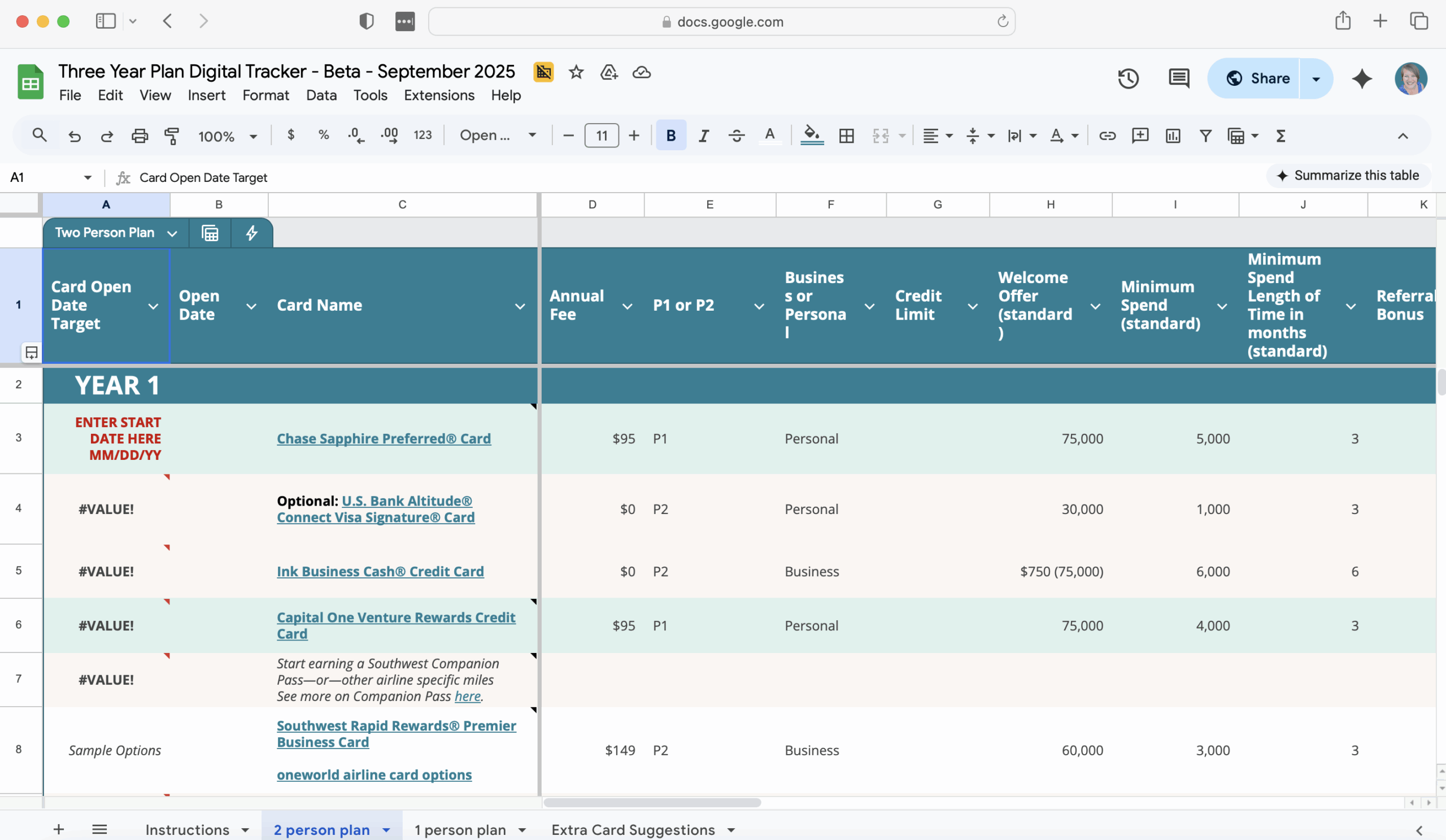
Drop your email below, and I’ll send you a digital tracker to chart your progress.

In three years, you’ll earn 1.3M+ points worth an estimated $18,000 to use towards flights, hotels, and other travel perks.

Year One

327,000 points

Year Two

491,000 points

Year Three

465,000 points

These annual charts give you the mile-high overview.

We’ll dig into the details in the sections below—but anytime you’re ready, you can grab your free digital tracker to follow along.
Now, let’s fill in the what, the
why, and the how behind each step.

Year One

When you’re starting out, the hardest part is knowing where to begin. There are so many cards and rules, and it feels like if you pick the wrong one, you’ll mess everything up. That’s why Year 1 of this plan is all about keeping things simple, building confidence, and stacking a big pile of points right away.

By the end of Year 1, you’ll have over 327,000 points and miles spread across three programs:

  • Chase Ultimate Rewards® (these are the most flexible and easiest to use–also great for our favorite hotel redemptions via Hyatt)
  • Capital One Venture miles (great for easy redemptions but flexible with other options, too)
  • Airline miles from a card that fits your home airport and your goals (look for one with an elevated offer)

All in all, that’s enough to cover multiple plane tickets, hotel nights, or even an entire vacation for a family. And you’ll do it without hurting your credit score or juggling more than you can handle. Use the expandable sections below to understand what to open and when, step by step.

Throughout the plan, we’ll label you as Person 1 (P1) and your partner as Person 2 (P2).

Note: With little consequence, you can start this plan at any point in the year. To keep things simple, I’m assuming you’ll start January 1.

Want to move cards around? You can shift cards to catch an elevated offer. Keep these limits in mind:

  • Before any Chase business card, be at 2/24 or below if you’re a sole proprietor (see our Chase 3/24 rule article), and hold no more than two Chase business cards.
  • Moving a personal card earlier can push you past 2/24. For example, a personal hotel card opened before P1’s Ink Business Unlimited® in January of Year 2 puts P1 at 3/24.
  • With Ink cards, the person referring needs one Ink open. The person being referred needs to not have any Ink open, or else the referrer won’t get the points.

We begin with the Chase Sapphire Preferred® Card. This card is the best “starter” in the points world because it keeps everything in one easy-to-use program called Ultimate Rewards®. You’ll earn a big welcome bonus (worth at least $750, and usually much more when transferred to travel partners).

Why Chase first? Chase has some of the most valuable points, but they also have one of the strictest approval rules: if you’ve opened too many cards in the past two years, they won’t approve you. That’s why we grab this card early—before anything else gets in the way.

You’ll use this card for your everyday spending and start earning a flexible pile of Chase points. Later in the plan, we’ll add more Chase cards that can combine with these same points, making them even more powerful.

Learn How to Apply for Chase Sapphire Preferred® here (affiliate link) >>

Resources

Application Notes

  • Chase’s “5/24” rule applies — if you’ve opened five or more personal cards in the last 24 months, you won’t be approved. This is why it’s important to start here.
  • As of June 23, 2025, Chase changed how points are valued through Chase Travel (usually worth less, sometimes more). Points are still easy to redeem and transfer to partners like Hyatt.
  • Extra perk: through December 31, 2027, you’ll also get $10/month in DoorDash credits (non-restaurant purchases).

Alternate Card Option

Don’t get scared by the word “business.” Almost everyone qualifies for a business card in the bank’s eyes. Selling items online, freelancing, tutoring, babysitting, dog walking—any side income counts.

The Chase Ink Business Unlimited® Credit Card  is one of the easiest ways to boost your points total. Here’s why it’s special: business cards don’t show up on your personal credit report, so they don’t make it harder to get approved for other cards later. You get the points without “using up a spot” in your 5/24 count. 

The welcome bonus often shows up as “$750 cash back,” but here’s the trick: when you pair this card with your Sapphire Preferred, those points turn into Ultimate Rewards® you can transfer to airlines and hotels. That makes them far more valuable than just cash back.

Learn How to Apply for Chase Ink Business Unlimited® here (affiliate link)>>

Resources

Application Notes

  • We have a full video walkthrough for first-time business card applicants.
  • People in her Facebook group have reported approvals with side hustles as small as $50/year in sales.
  • You’ll want to be at 2/24 or below if you’re a sole proprietor (see our Chase 3/24 rule article).

Alternate Card Options

Next, we’ll branch out a little and add the Capital One Venture Rewards Credit Card. Why now? Capital One can be picky about approvals if you’ve opened a lot of cards recently, so we want to lock this in early.

This card comes with one travel perk that will make your life easier right away: Global Entry or TSA PreCheck credit (skip the long lines at the airport).

It also earns flexible miles you can use toward almost any kind of travel. 

Learn How to Apply for Capital One Venture Rewards Credit Card here (affiliate link) >>

Resources

Application Notes

  • Capital One is finicky about approvals. Generally, the more recent accounts/inquiries you have, the harder it is to get approved.
  • Some people report better approval odds by checking the box that says “I plan to carry a balance” (you should never actually carry a balance — it’s non-binding, but signals profitability to Capital One).
  • Another thing that can help is keeping your Experian credit report frozen when you apply.

Alternate Card Option

  • Capital One Venture X Rewards Credit Card: This card used to be the standard recommendation for the Three-Year Plan but with guest access changing for airport access in Feb 2026, we moved it down to an alternate option.  It still has strong potential value: $300 annual travel credit + 10,000 bonus miles each year on your anniversary.
  • Not interested in Venture miles? You could start earning another kind of flexible rewards. In that case, I’d suggest a Citi Strata Premier® or American Express Green Card. 

Round out Year 1 with an airline card of your choice. Three things to look for: an elevated welcome offer, a business card (it won’t add to P2’s 5/24 count, which keeps Chase approvals easier later), and a bank other than Chase if you can. Check our Best Offers page for current airline card offers.

At the end of Year 1, you’ll be sitting on over 300,000 points and miles. That’s enough for:

  • Multiple domestic round-trip flights
  • Several free hotel nights (Chase → Hyatt is a favorite strategy)
  • Global Entry already covered for two adults + all kids under 18

Most importantly, you’ll have learned how to follow a clear plan without feeling overwhelmed. Every card has a reason, every step builds on the last, and you’ll end the year confident instead of confused.

Year Two

In Year 2 of the plan, you’ll double down on earning Chase Ultimate Rewards®. We love these points for their flexibility and strong value. We just can’t get enough of them! You will start leveraging referral bonuses in your household, too. You’ll also branch out into hotel-specific points.

By the end of Year 2, you’ll earn about 491,000 points and miles spread across two programs:

  • Over 300,000 Chase Ultimate Rewards® (you can transfer them to Hyatt, book via Chase Travel(sm), or transfer to airline partners)
  • Enough hotel points with another program for a few nights!

As much as we love Ultimate Rewards, you still need to pace yourself. It’s important to establish a good relationship with banks and avoid opening too many cards too quickly. We recommend never opening more than four cards with Chase in any rolling 12-month period, ideally fewer than four!

Now that you have one Ink card in your household, the referral fun can begin!

Ink cards currently offer a 20,000 point referral bonus. Ink cards also offer “family” referrals which means if you hold ANY Ink card, you can refer a friend to ANY Ink card. This family also includes the Sapphire Reserve® for Business.

So when P2 refers P1 to an Ink Business Unlimited® Credit Card, you’re earning a 20,000 point referral bonus on top of the welcome offer.

Generate a referral here >> 

Note:  Chase terms state that Ink referrals will only be awarded to “new Chase Business card customers only. Referrals of individuals with existing Chase business card accounts will no longer qualify for the referral bonus.” It is only possible to earn a  referral again later if the person applying doesn’t have any Ink cards when they are referred and the plan assumes this in the timing of the Ink cards.

Now it’s P1’s turn to add a hotel-specific stash of points. There isn’t one best hotel program for this.

That said, we usually recommend starting with Hyatt as your main program. It’s easy to understand, consistently offers good value, and the credit card is a long-term keeper.

Even though the Hyatt personal card doesn’t usually have flashy welcome offers, we consider it a keeper. The annual fee is $95, but each year, you’ll earn a free night certificate (Category 1–4 hotel) on your anniversary. We often redeem that free night for a Chicago staycation worth $250–$300. In our minds, that’s a prepaid, discounted vacation.

Other hotel cards—especially when they’re offering an elevated bonus—can easily cover a 3–5 night stay.

Ultimately, choose a hotel program that works for you:

  • Maybe there’s a specific destination or hotel you’ve been eyeing.
  • Or maybe you want to jump on a strong welcome offer.

The good news? Most of our favorite hotel cards are “keepers,” thanks to the free hotel night you get every year on your cardmember anniversary.

Read our guides here.

Application Notes

If you don’t already have lounge access through another card, you might want to consider getting on a pathway to the Chase Ritz Carlton® Card. You’ll need to open another card first, wait a year, and then upgrade to the Ritz card. A hassle? Yes, but this Ritz boasts the strongest lounge access of any card out there. Read more here.

Resources

Browse our maps for more inspiration!

You’re going to be evaluating the Ink card you opened Year 1 in April (or whenever you opened it). It’s a good practice to do this with any card every year. 

Before you make any changes to this card, make sure you’ve: waited for your referral bonus to post, moved all your points to a Sapphire card, and held the card at least 12 months. Then decide if it still earns its spot in your wallet. One thing to keep in mind: if P2 still has an Ink open in October, P1 can’t earn a referral bonus for referring P2 to the Ink Business Preferred®. Chase now only pays Ink referrals for people without an open Chase business card.

Resources

The “two person” plan includes a lot of referrals back and forth and here’s the next one!

With the Chase Sapphire Preferred, the referral bonus is currently 15,000 Ultimate Rewards points.

You’ll refer your P2 to this card so they can earn a bonus – and then the P1 will also get a referral bonus.

You’ll be able to combine your points across your household as well.

Generate a referral here >>

Application Tips

Generally, I think it’s better to apply regularly for cards than sit around waiting for a limited time offer to pop up. 

That being said, for the past few years, we’ve seen an elevated offer for the Sapphire Preferred in late spring–sometime between mid April and mid June. You might want to watch for it and see if it fits with your timing!

Ink referrals are a powerful part of this strategy! Here’s why:

  • Family referrals: If you hold any Chase Ink card, you can refer someone to any other Ink card. This “family” even includes the Sapphire Reserve® for Business.
  • Step 1: P1 should refer P2 to the Ink Business Preferred® Credit Card.
  • Step 2: P2 earns the new card’s welcome bonus.
  • Step 3: P1 earns a 20,000-point referral bonus on top.

That’s why we love referrals—you’re stacking points on both sides at once.

Generate a referral here >>

Remember: After October 7, 2025 – Chase terms state that Ink referrals will only be awarded to “new Chase Business card customers only. Referrals of individuals with existing Chase business card accounts will no longer qualify for the referral bonus.” P1 won’t earn a referral bonus if P2 already has an Ink card open.

Update November 2025: Chase has tightened eligibility for Ink approvals. If you already got a no-annual fee Ink, you are more likely to be approved for either the Ink Preferred or Sapphire Reserve for Business. One notable exception is if you have an LLC, LLCs seem to be approved more readily for additional no-annual fee Inks.

At the end of Year 1, you opened an airline card. Now it’s time to decide whether it’s worth keeping past that first year. 

With airline miles–even if you cancel a card, your miles are safe. You don’t need to keep these cards open to keep your points alive. 

You do need to take a minute and look at the annual fee and look at the benefits you’re getting and see if it balances out for you. 

Resources

Year 2 is fairly simple. 

It does require you to do some research and pick a hotel card. Don’t let analysis paralysis stop you from picking one. There are a lot of good hotel cards out there and you have to start with one of them. You can add more later!

Since you’ve doubled down on Ultimate Rewards this year, you can really become an expert in using them. 

If you’re ready to start opening cards more quickly than this plan allows, you can. Keep your 5/24 scores in mind. Generally, it’s best if you open additional non-Chase cards. This plan optimizes for Chase cards but leaves room for you to add cards from other banks. 

Year Three

By Year 3, we hope you’re starting to feel comfortable with earning and redeeming points. Here’s the good news: you don’t really have to learn anything new this year. It’s more of the same good stuff!

In Year 3, you’ll earn about 465,000 points, including:

  • More hotel-specific points–you could double down on what you earned last year or pick a new program
  • More Ultimate Rewards (are you surprised?)
  • More Venture miles
  • More airline miles from a card of your choice

Two years ago, P1 started this plan by opening a Chase Sapphire Preferred® Card. It’s the key to making a lot of the rest of the plan work. It allows you to convert the cash back from Ink cards to Ultimate Rewards that can then be transferred to Hyatt and other partners.

But technically you only need one Sapphire card per family. That’s because you can combine points across your household into one Sapphire account and transfer out from there.

Some households choose to minimize their annual fees as much as possible and if that’s you–you can go ahead and downgrade your Sapphire card now.

If you find the $95 annual fee to be well worth the value you’re getting from other benefits, you can also choose to both keep your Sapphire cards.

Downgrade Options

You’ll be able to downgrade to Freedom cards.

Our general recommendation is to ask for the “Visa Freedom with Ultimate Rewards” or “Classic Freedom.” This is a now discontinued card that has rotating categories that earn 5x every quarter on a maximum of $1500. It can be a great way to keep earning points if you can max out those categories.

This is a good time for P2 to get their own Venture card (with the P1 referral). This would enable P1 (the original owner of the Venture) to downgrade the Venture to a no annual fee version or cancel it so you aren’t paying that annual fee twice.

Don’t cancel P1’s Venture card unless P1 has first moved their Venture miles over to P2’s new Venture. Capital One makes that easy because they allow you to move Venture miles to anyone. 

Capital One sometimes won’t let you downgrade if you don’t call right before the date your annual fee is due, so watch this part of the timeline closely. P2 will want to apply at least a few weeks before the date that P1 will be charged the Venture annual fee.

Resources

Application Notes

  • Capital One is finicky about approvals. Generally, the more recent accounts/inquiries you have, the harder it is to get approved.
  • Some people report better approval odds by checking the box that says “I plan to carry a balance” (you should never actually carry a balance — it’s non-binding, but signals profitability to Capital One).
  • Another thing that can help is keeping your Experian credit report frozen when you apply.

Alternate Card Option

  • Capital One Venture X Rewards Credit Card: This card used to be the standard recommendation for the Three-Year Plan but with guest access changing for airport access in Feb 2026, we moved it down to an alternate option. It still has strong potential value: $300 annual travel credit + 10,000 bonus miles each year on your anniversary.
  • Not interested in Venture miles? You could even start earning another kind of flexible rewards. In that case, I’d suggest a Citi Strata Premier® or American Express Green Card.

If you were happy with whatever P1 picked in Year 2, they can probably refer P2 to the same card! Or if you have a specific travel plan in mind, pick another hotel card.

Ultimately, choose a hotel program that works for you:

  • Maybe there’s a specific destination or hotel you’ve been eyeing.
  • Or maybe you want to jump on a strong welcome offer.

You could prioritize business cards to stay under 5/24 or prioritize opening a hotel card from a bank that isn’t Chase at first so you’re diversifying the banks you’re getting cards from.

The good news? Most of our favorite hotel cards are “keepers,” thanks to the free hotel night you get every year on your cardmember anniversary.

Read our guides here. 

Application Notes

If you don’t already have lounge access through another card, you might want to consider getting on a pathway to the Chase Ritz Carlton® Card. You’ll need to open another card first, wait a year, and then upgrade to the Ritz card. A hassle? Yes, but this Ritz boasts the strongest lounge access of any card out there. Read more here.

Resources

Browse our maps for more inspiration!


You’ll be evaluating the Ink card you opened in Year 2 (January, or whenever you started).

Before you make any changes to this card, make sure you’ve: waited for your referral bonus to post, moved all your points to a Sapphire card, and held the card at least 12 months. Then decide if it still earns its spot in your wallet. One thing to keep in mind: if P1 still has an Ink open in August, P2 can’t earn a referral bonus for referring P1 to the Ink Business Preferred®. Chase now only pays Ink referrals for people without an open Chase business card.

Resources

You don’t need to keep 2 Venture cards in your household–Capital One makes it really easy to combine your points. 

But it’s still better to downgrade rather than cancel the card altogether. This helps keep your credit report strong and maintain a better relationship with the bank. 

Double check that you got your referral bonus back in January before you do!

You could also choose to move your points to your partner’s Venture card before downgrading. 

Once those things are done, you can go ahead and call to downgrade.

Capital One doesn’t always give everyone the same downgrade options. If you have the option for VentureOne, that’s what I’d recommend. Otherwise you can pick from the options they give you.  

Resources

Remember that Ink cards offer “family” referrals which means if you hold ANY Ink card, you can refer a friend to ANY Ink card. This family also includes the Sapphire Reserve® for Business.

P2 should refer P1 to the Ink Business Preferred® Credit Card.

And then P2 is earning another 20,000 point referral bonus on top of the welcome offer.

Generate a referral here >>

Remember: After October 7, 2025 – Chase terms state that Ink referrals will only be awarded to “new Chase Business card customers only. Referrals of individuals with existing Chase business card accounts will no longer qualify for the referral bonus.” That’s why P1 evaluated their Ink Business Unlimited® back in May.

Update November 2025: Chase has tightened eligibility for Ink approvals. If you already got a no-annual fee Ink, you are more likely to be approved for either the Ink Preferred or Sapphire Reserve for Business. One notable exception is if you have an LLC, LLCs seem to be approved more readily for additional no-annual fee Inks. 

Same three things to look for as P2’s airline card in Year 1: an elevated offer, a business card if you can (personal is fine for P1), and a bank other than Chase. Check our Best Offers page for current airline card offers.

You’ll be evaluating the Ink card you opened in Year 2 (October, or whenever you started).

Before you make any changes to this card, make sure you’ve: waited for your referral bonus to post, moved all your points to a Sapphire card, and held the card at least 12 months. Then decide if it still earns its spot in your wallet.

If the $95 annual fee isn’t worth it anymore, ask Chase about downgrading to a no-annual-fee Ink instead of closing it.

Resources

You’ve made it to the end of three years and earned over a million points! We hope you’ve taken some memorable trips and feel ready to creating your own points strategy to take vacations every year.

As you continue on, we hope you find our in-depth resources helpful. Check out our Destinations Page for tips on hotels and detailed flight guides, too.

“But Katie, I have a question!”

Like I said, this can be a lot to take in, so I expect you’ll have questions! Here are the ones
we tend to answer a lot. If you have others, you can check the Facebook group or contact us here.

Yep, you sure can! There’s almost nothing in the plan that’s time-sensitive.

If you’ll be applying for business cards as a sole proprietor, you do need to watch your x/24 count. The plan assumes you start at 0/24.

I mean this sincerely, there is no best way. 

The best way is any way that allows you to travel and be a part of an experience that you find valuable. 

I’m not a strong proponent of standardized “cents per point” comparisons and calculations because I find they lead more to bragging rights and FOMO for others more than adding valuable memories to your life. 

Now, getting off my soap box, I will point you towards all the resources on our site where you can find inspiration. 

Start with our Destinations Page which is full of them!

If you want to move faster than my plan, you can! You’re just going to need to keep the following in mind.

Velocity With Chase

I don’t recommend you apply for more than 3 cards from Chase in any given 12 month period. Space out your cards and apply for cards from other banks, too.

Watch Your 5/24 Count

My plan keeps you under 5/24 at all times so that you always have the option to apply for Chase cards. It actually now almost always keeps you under 3/24 so that if you’re a sole proprietor you always have the option for Chase business cards. I love the flexibility to do this when a great offer comes out—especially if it matches with some bigger spending I have coming up. You can add in personal cards to this plan, but just be mindful of how that will affect your 5/24 status.

Jump on Elevated Offers

Sometimes a great elevated offer comes around and you want to grab it! You can see all my current favorite offers here.

My Favorite: Apply for Business Cards from Other Banks

This is my personal favorite way to add more cards into my wallet (and more points into my loyalty accounts)!

Check the next FAQ for my list of recommended cards.

Opening non-Chase business cards is the perfect way to keep earning points or cash back but still be eligible for all the cards in this plan.

You could add any of these at any time to the plan:

American Express Cards

  • The Blue Business® Plus Credit Card from American Express – Doesn’t have a high offer (Except occasional highly targeted offers) but does allow you to start earning Membership Rewards which then allows you to link Rakuten to Membership Rewards earning
  • American Express® Business Gold Card
  • The Business Platinum Card® from American Express
  • Marriott Bonvoy Business® American Express® Card
  • Hilton Honors Business Card
  • Any Delta Business Card

Bank of America Cards

Capital One Cards

Citi Cards

US Bank Cards

Barclays

  • JetBlue Business Card
  • Hawaiian Business Card
  • Wyndham Business Card

Yes, you can!

There’s a lot of flexibility to this plan.

It’s always fine to move cards around according to when you need the points or when an elevated offer pops up.

That being said–you need to watch your velocity with Chase and the spacing of your Ink cards especially if you move cards around.

I originally released a Three-Year Plan in March 2024. You can find an archived version here.

I released my first update to it in September 2025.

It is now on its 2nd update for October 2026.

Chase is making it harder for sole proprietors to get approved for cards if they are at 3/24 or above, so I switched some cards around to help people stay eligible for Ink cards longer.

I removed the U.S. Bank Altitude Connect — that’s because I don’t think it’s worth a x/24 slot if that prevents you from opening a business card down the road.

I removed the Southwest Companion Pass from the Three Year Plan after Southwest announced major changes that made this impossible to earn with welcome offers.

Finally, I adjusted some of the card timings to fall when we occasionally see elevated offers. Overall, I believe it is more important to be consistently opening cards rather than waiting around for elevated offers. But we all love the thrill of getting an elevated offer, too. In Year Two and Year Three, I tried to align cards if I could with times we have seen elevated offers in the past. A past elevated offer is never a guarantee of a future one–but sometimes we do see patterns over time.