
All content was accurate at the time of publication. Check issuer’s site for most up to date information.
katiestraveltricks.com has partnered with CardRatings for our coverage of credit card products. katiestraveltricks.com and CardRatings may receive a commission from our partners. This compensation may impact how and where links appear on this site. This site does not include all financial companies or all available financial offers. For Capital One products listed on this page, some of the above benefits are provided by Visa® or Mastercard® and may vary by product. See the respective Guide to Benefits for details, as terms and exclusions apply.
How to Use Credit Card Points Without Transferring to Partners (for good value)
Before we get started, it’s important to say that any way you use your points is a win. When you’re using points to travel more, enjoy more experiences, or get a discount on things you actually want, that is always going to be better than leaving points in your account unused.
We are here to help you learn how to earn and use points in a way that adds value to your life. Not put pressure on you to get the “best” value.
That being said, there are some tips and tricks that can help you stretch your points further. Transferring points to hotel and airline partners can be a good way to get more value out of your points, but it’s not always the best deal. This post is all about getting strong value from your points even when you don’t transfer them to travel partners.
What Is Cents Per Point? (And How Much Is a Credit Card Point Worth?)
Cents per point refers to the dollar value you get from each point. If you redeem 10,000 points for a $100 plane ticket, you’re getting 1 cent per point. If you redeem 10,000 points for a $200 plane ticket, you’re getting 2 cents per point.
To calculate cents per point, take the dollar amount of your travel expense and divide it by the points used to reserve it. $100 divided by 10,000 = .01 so that = 1 cent per point. $200 divided by 10,000 = 2 cents per point.
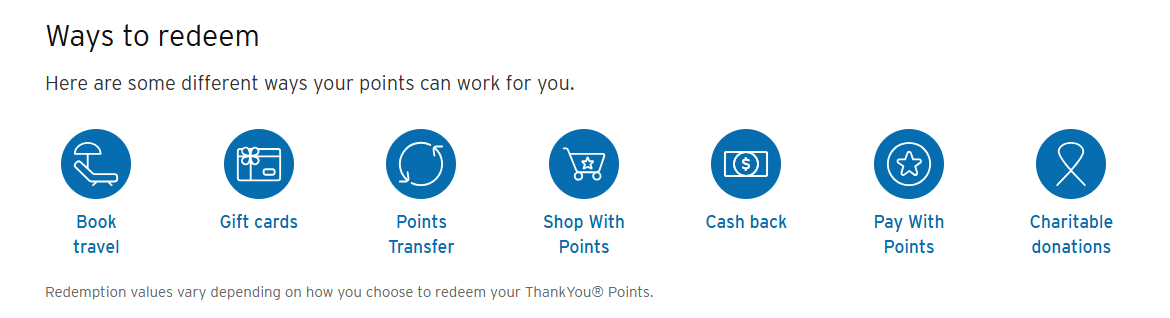
Points can be redeemed in a lot of different ways and some people like to use cents per point (or CPP) to determine whether or not they’re getting good value for their points.
Should I Care About Cents Per Point?
That’s totally up to you. You can get a ton of value from your points without ever calculating a single cents per point value.
Some people like to calculate how many cents their points are worth for every single redemption, and if you enjoy doing that, that’s great! But if calculating stresses you out, then there’s no reason to do it every time.
For some people, getting maximum cents per point value is a big goal when using their points and miles.
Other people just want to use their points for travel in whatever way helps them save the most actual cash, even if it means getting lower cents per point. And sometimes you’ll use both of these strategies, and that’s okay too!
Sometimes it can feel like you’re doing it wrong if you’re not getting top value from your points with every redemption, but that’s just nonsense! Cents per point is one way to measure the value you get from your points, but it’s not the only way.
Cents Per Points Misnomers and Manipulation
One reason we don’t advocate for cents per point as the ultimate benchmark of value is that it is easily manipulated and doesn’t necessarily match real life alternatives.
One classic example is how people calculate cents per point on flights. In award travel, it often makes sense to break a round trip flight into two separate segments, as it can be easier to find availability this way. You might even fly one way on one airline and return home on another. This might cost you the fewest miles out of your pocket.
But if you go to price a one way flight in cash, it’s typically not half of what it might cost for a round trip. In fact, sometimes the one way is almost the same as the round trip price. So if you’re calculating cents per points for your one way award redemptions and comparing them to the exact same one way cash prices, you’re often getting a very inflated number.
This also doesn’t match reasonable behavior — which is what you’d book if you were paying in cash. Let’s say you’re flying from Chicago to Paris and want to go nonstop. You might find you’d use the fewest number of miles and points if you book via United but the cash rate on Air France is actually a lot cheaper than the cash rate on United due to fare sales that day.
To me, that doesn’t mean it’s a bad redemption to book United even if it is a lower cents per point — in fact, I’d say its better to use fewer points!
If you do want to think about cents per point, here is what I like to keep in mind.
Aim for Genuine Value, Not Hypothetical Value
Hypothetical value and actual value are not the same. What’s valuable to one person isn’t as valuable to someone else, and what’s valuable to you personally could change depending on the trip and who you’re traveling with.
Getting a high cents per point is a good way to get hypothetical value from your points, but sometimes a lower rate gives you more genuine value.
Here’s an example of what I mean.
You can typically get the highest cents per point on luxury hotel stays and business class airfare. These types of redemptions still cost a lot of points, even if you’re getting a good deal. For example, a business class ticket to Europe (one way) might cost 80,000 points while an economy class ticket costs 20,000. The business class flight costs a lot more in cash, so it might give you 5 cents per point value while the economy class ticket gives you 1.5 cents per point.
If you’re going by cents per point, the business class ticket looks like the better value, but that’s just hypothetical value. For a lot of people, getting 4 economy tickets for 80,000 points has more genuine value than getting 1 business class ticket for the same price.
Aim for a Minimum of 1 Cent Per Point
As a general rule of thumb, I like to redeem transferrable points for a minimum of 1 cent per point. The reason is that I have several cards where I can redeem points for cashback at a rate of 1 cent per point. If the redemption is going to be less than that, it’s a better value to pay cash for the purchase, then use points to pay myself back.
For example, if I want to use points to pay for something that costs $100 at Amazon, I could use 12,500 Ultimate Rewards points at checkout to pay for the purchase directly with Amazon. That gives me a rate of 0.8 cents per point
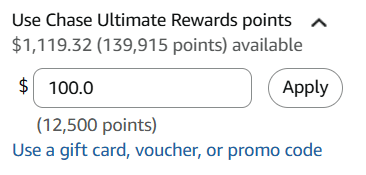
OR I could charge the purchase to my Chase credit card, earn 100 points on my card for the purchase, then redeem 10,000 points for $100 cashback to cover the purchase.
I’m still using points to pay for the purchase, but by doing it this way, it costs me fewer points. Those extra points can then be used for something else down the road.
How to Maximize Your Credit Card Points With a Bank Travel Portal
Whether or not you care about cents per point, there are some ways to maximize the value you’re getting out of your points! We’ll start by looking at using points in a bank travel portal.
Before you book in a bank travel portal, be sure to read through our article on what to know and pros and cons.
Booking flights, hotels, and car rentals through credit card travel portals (like Citi Travel, Chase Travel℠, or Capital One Travel) can be a good way to use your bank points directly without having to transfer them.
In most cases, your points will give you a straightforward 1 cent per point value this way. 10,000 points covers $100 worth of travel.
Note: If you had a Chase Sapphire Reserve® or Chase Sapphire Preferred® Card before June 23, 2025, points earned before October 26, 2025 may be worth up to 1.25 or 1.5 cents per point in Chase Travel℠ through October 26, 2027. This doesn’t apply to new cardholders.
Booking Hotels in the Travel Portal
When booking hotels, using your points to pay through a bank travel portal can often give you a better value than transferring points to the hotel chain to book. Here’s an example:
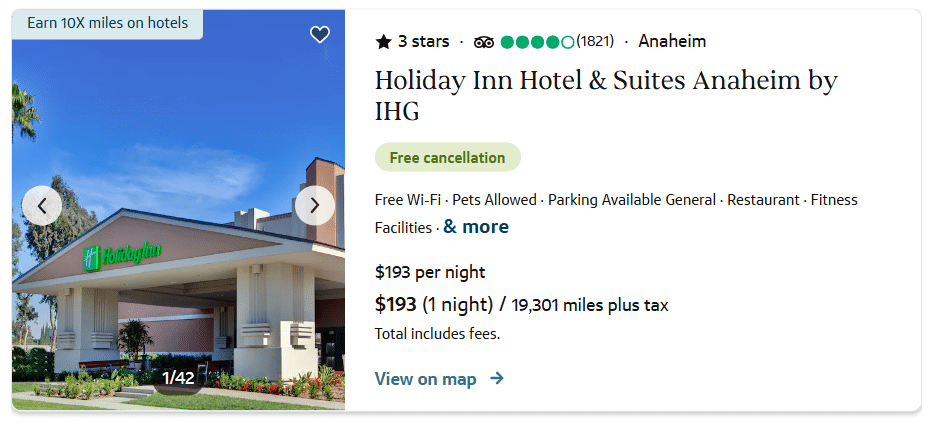
This Holiday Inn near Disneyland is 33,000 points for a night in May when booked through IHG.

You can book the same hotel through Chase Travel for 25,122 points per night (including all taxes and fees). This is the same room on the same night, but by using your points in the travel portal, you save nearly 8,000 points per night. Plus if you have a Chase Sapphire Preferred® Card, you’d be able to use your $100 annual hotel credit!
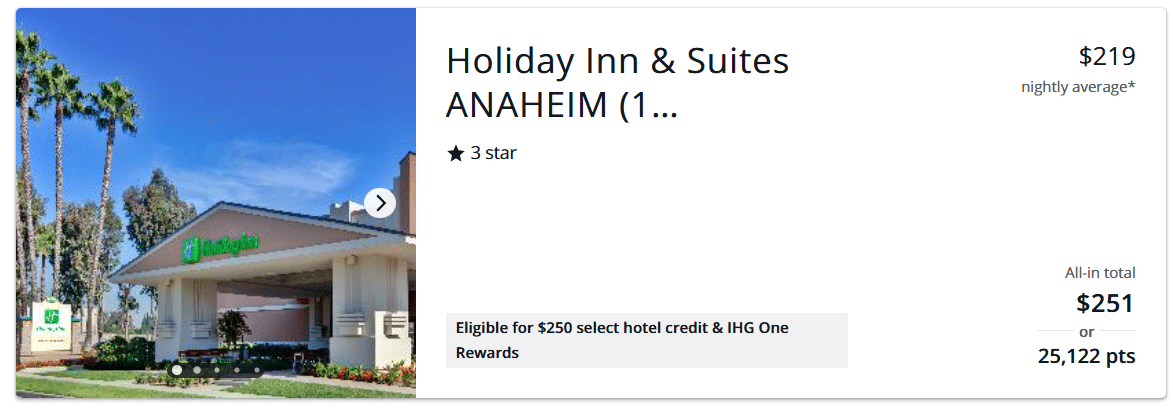
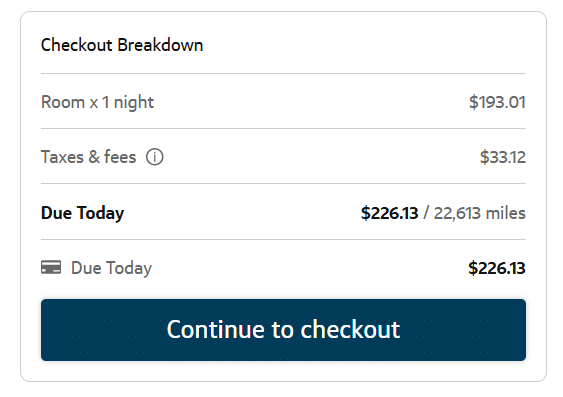
If you also have Capital One miles, you can book the same hotel in Capital One Travel for just 22,613 points per night (including all taxes and fees). Capital One miles don’t transfer to IHG anyway so this would be your main option to use Capital One miles to book this hotel.
Pro Tip: Don’t Actually Use Points Directly in the Portals
To really maximize the points you’re earning and spending, the best deal in this scenario is to book the hotel through the bank travel portal (or directly with the hotel) but do not use your points to pay when you check out.
Charge the total to your card first. When booking in a bank travel portal, many cards give you extra points, like 8x or 10x points per dollar. For instance, if you have a Capital One Venture X, you earn 10x points per dollar on hotels booked through Capital One Travel.
For this example, you would earn 2,261 points for the $226.13 price of the room.
Then, you can use the “cover travel purchases” feature through Capital One to use points to erase that charge from your bill at a 1:1 ratio.
With this strategy, you’re still using the same 22,613 miles to cover the purchase, but you also earned over 2,000 points in the process!
It works essentially the same way if you book through Chase Travel (or another bank travel portal). If you book the $251 room through Chase Travel and put the charge on your Sapphire Preferred Card, you would earn 1,255 points on the purchase (5x points per dollar). Then you can redeem cashback at a 1:1 ratio to cover the cost.
With Chase specifically, the exception to this is if a hotel or flight you’re looking at has a better Points Boost rate (see below) — or if you still have the higher 1.25cpp or 1.5cpp rates grandfathered in.
The math doesn’t always work out this way, but it often will
You won’t automatically get a better value every time by booking in the travel portal, so it is always worth it to check what the price would be through the hotel and the bank’s travel portal to see which option gives you the best value.
Hyatt is one brand where it doesn’t always work out this way. When you book a Hyatt hotel, you’ll often pay fewer points by transferring your points to Hyatt first rather than booking in a bank travel portal.
Chase Points Boost
Points Boost through Chase Travel is another way you can stretch your points further.
Select hotels and flights offer Points Boost, making your points worth up to 2 cents per point each. You can tell which properties offer Points Boost by the little rocket symbol.
Not all hotels are included (and mostly just premium flights) but if there is an option that works for you, this can be a good way to get more value out of your points.

You need a Chase Sapphire Preferred® Card, Chase Sapphire Reserve®, Sapphire Reserve for Business℠, or Ink Business Preferred® Credit Card to have access to Points Boost.
Booking Flights in a Travel Portal
When cash prices are reasonable, booking flights in a travel portal and using your points to pay can make more sense than transferring to an airline to book the same flight.
For instance, flights to Europe from the U.S. can often be found for under $500 (roundtrip in economy) even from smaller airports. You could use 50,000 points in a bank travel portal to cover a $500 flight. This will often give you a better value (and be simpler) than transferring points to an airline to book.
Plus, when you book with points through the airline, you’ll always have some taxes and fees to pay. In the U.S it’s usually $5.60 each way, but for international flights it can be a lot more.
When you’re booking flights through the portal, your taxes and fees are included in the price, so it’s possible to cover the entire fare on points and pay $0 in cash.
When you book a flight in a bank travel portal, you can attach your loyalty number to the booking, and you’ll still earn points and be eligible for any status benefits you would normally get.
Use a Travel Portal or Book Direct
The main reasons to book in a bank travel portal are to use credits (like the $100 hotel credit that comes with the Sapphire Preferred) or get elevated earning rates (like 10x points when using the Venture X to book hotels in Capital One Travel).
If you’re planning to charge the purchase to your credit card and then redeem points to cover the purchase, you may also want to consider booking your travel directly with the hotel or airline.
Our post on booking travel in a bank travel portal walks you through all the pros and cons to help you decide which type of booking is the best fit for your trip.
Other Ways to Get More From Your Credit Card Points Without Transferring to Partners
Aeroplan Pay Yourself Back
With the Chase Air Canada Aeroplan® Credit Card, you can use points to cover any travel expense at a rate of 1.25 cents per point. That means 10,000 points will cover $125 worth of travel.
This is already a good deal, but if you also have cards that earn Chase Ultimate Rewards points that can be transferred to partners, it gets even better.
You can transfer 100,000 of your Ultimate Rewards points to Aeroplan and that would cover $1,250 worth of travel expenses using Pay Yourself Back. If you make your transfer during a transfer bonus, you could get even more points. Chase sometimes offers transfer bonuses to Aeroplan where you can get a 20% bonus on any Ultimate Rewards points you transfer during the promotional period. (Transfer bonuses usually last a few weeks, and we see them come around 1-3 times a year).
If you transfer 100,000 points during a 20% transfer bonus, you would end up with 120,000 points and those could be used to cover $1500 in travel!
You need a Chase Sapphire Preferred® Card, Chase Sapphire Reserve®, Sapphire Reserve for Business℠, or Ink Business Preferred® Credit Card to be able to transfer Ultimate Rewards points to partners like Aeroplan.
We have a whole post about paying yourself back with Aeroplan to help you learn more about how this works.
Redeem Points for Cashback
Redeeming points for cashback is a simple and easy way to get good value out of your points. With cashback, you can use points to cover any expense.
This is often one of the best ways to cover purchases like cruises, theme park tickets, and vacation rentals on points. You can’t transfer points to buy Disney tickets, but you can buy $1,000 worth of tickets and use 100,000 points to cover that cost by redeeming your points for cashback.
Most credit cards allow you to redeem points for cashback as a statement credit directly on your account. Cashback can generally be redeemed at any time, as long as you have points available.
Rates can vary depending on which card you have. Many cards offer 1 cent per point for cashback, but some offer less.
Combining Points on The Right Card
Most banks allow you to combine the same types of points across multiple cards. For example, if you have the Citi Strata Elite℠ Card, Citi Double Cash® Card, and Citi Custom Cash® Card, you can combine the points from all of those cards onto one account.
This matters because points on the Strata Elite card can only be redeemed for cashback at a rate of 0.07 cents per point.
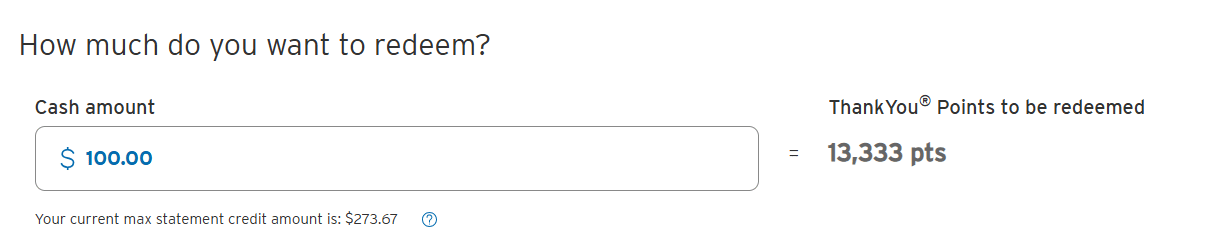
But points on the Custom Cash or Double Cash cards can be redeemed for cashback at a rate of 1 cent per point. That means your points go further.
To make the most of your points, move the points you want to redeem over to the card that gives you the highest value before redeeming them for cashback.
Pay Yourself Back / Purchase Eraser
This is similar to redeeming points for cashback, but instead of getting general cashback, you’re using points to cover specific purchases on your card.
For some cards like the Capital One Venture X, when you redeem points for cashback, you get a lower rate. For the Venture X, it’s 0.05 cents per point, so 10,000 points would only be worth $50 cashback. But when you redeem the same points to cover travel purchases, you get 1-1 value.
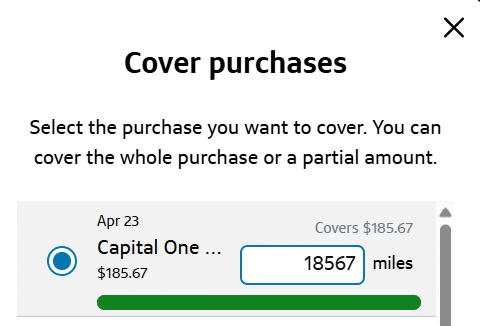
In this case, it’s a much better value to use the points for specific travel expenses. This works for anything that codes as travel. Hotels, flights, parking, cruises, rideshares, ferries, public transportation, Airbnb, and more typically code as travel.
Pay with points on Amazon
As mentioned above, this is generally not a good value. But, there are occasionally promotions where it can make sense to use some points to pay with Amazon.
Amex and Discover both occasionally have promotions where you can use points to pay and get a discount off your purchase.
There is usually a minimum number of points required (like $5 or $10 worth of points) and a maximum discount ($40 or $50 off is common).
Spending $5 worth of points to save $40 in cash can absolutely be worth it.
We include these types of deals in our weekly newsletter. Subscribing is a good way to find these deals when they come around.
Redeem Points for Gift Cards
This is generally a good value only when there is a promotion. If you’re going to get a gift card, you will generally get better value from buying the gift card directly from the merchant to earn points first, then using your points to offset the purchase.
But sometimes, you can get a discount (like 10-15% off) by redeeming points for certain gift cards. This can be an inexpensive and easy way to get a little more value out of your points. Just make sure you’re going to use that gift card!
Are You Ready To Redeem Your Points?
All of these options can seem overwhelming at first, but the more you practice using points and miles, the more you’ll be able to easily recognize what’s a good value and what isn’t.
And don’t sweat it if you’re not getting the best value out of your points every time. Sometimes it’s worth spending more points for convenience.
Whenever you’re using points to add value to your life, it’s a win!
Table of Contents
Related Posts




Responses are not provided or commissioned by the bank advertiser. Responses have not been reviewed, approved or otherwise endorsed by the bank advertiser. It is not the bank advertiser’s responsibility to ensure all posts and/or questions are answered.
