
All content was accurate at the time of publication. Check issuer’s site for most up to date information.
katiestraveltricks.com has partnered with CardRatings for our coverage of credit card products. katiestraveltricks.com and CardRatings may receive a commission from our partners. This compensation may impact how and where links appear on this site. This site does not include all financial companies or all available financial offers. For Capital One products listed on this page, some of the above benefits are provided by Visa® or Mastercard® and may vary by product. See the respective Guide to Benefits for details, as terms and exclusions apply.
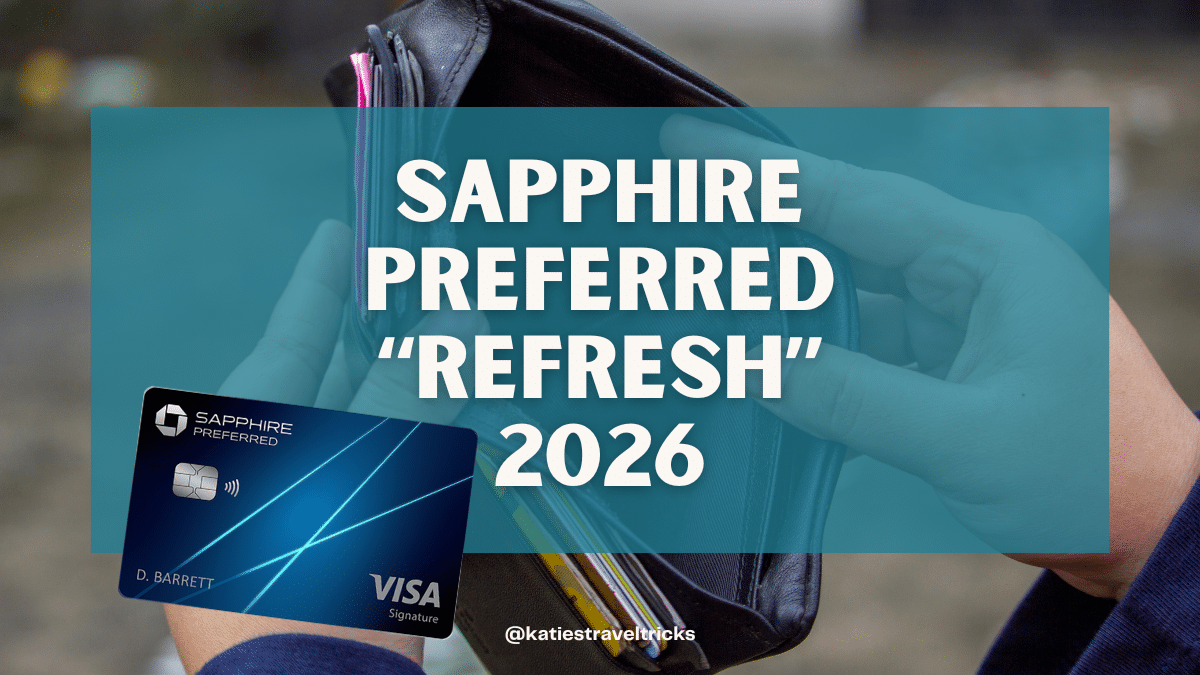
Chase Sapphire Preferred® Card “Refresh” 2026
Significant changes are coming to the Chase Sapphire Preferred® Card starting June 15, 2026 — and depending on how you use your points, they could cost you serious value…or add to it. Here’s a breakdown of everything that’s changing, what it means for you, and how to protect your points.
Annual Fee will stay the Same
First, I will say the annual fee will remain the same at $95.
That’s a plus, many assumed a refresh would come with a higher annual fee.
The Negative Changes
Hyatt Transfer Ratio Drops to 4:3
The biggest change is the transfer ratio from Ultimate Rewards® to Hyatt. If you apply for a Chase Sapphire Preferred® Card on or after June 15, 2026, your transfer ratio to Hyatt will be 4:3 immediately. That means if you transfer 100,000 Ultimate Rewards points, you’d end up with only 75,000 Hyatt points.
If you already held a Sapphire Preferred before June 15, 2026, this change goes into effect on October 1, 2026. You have until then to transfer at the 1:1 ratio.
The Chase Ink Business Preferred® Credit Card will also be affected, but with a slightly different timeline. New and existing cardholders switch to the 4:3 rate on October 1, 2026.
The Chase Sapphire Reserve® and Chase Sapphire Reserve for Business℠ are not affected — those cardholders will continue to transfer points to Hyatt at a 1:1 ratio.
My Take: I hate to see this for two main reasons. First of all, because transferring to Hyatt is such a popular redemption option for so many people in our community, this will really be a loss of value for a lot of people. It’s always been a beginner-friendly, very easy-to-understand way to redeem points. That’s a 25% reduction in value, which is really significant. Secondly, it feels like a slippery slope of reducing transfer ratios. Chase has always had every partner at a 1:1 ratio which has also made it easy to understand and explain. Now it varies by card and loyalty program, which makes me wonder if this has just opened the door on more ways to reduce points value down the road.
It seems pretty clear that Chase is trying to drive more people to open a Chase Sapphire Reserve over the Sapphire Preferred. And while personally I do really like the Reserve (benefits are pretty easy for me to use where I live), I know the $795 fee is out of the realm of normalcy for many people so this change is yet another one that feels like it hits “normal” people more.
10% Anniversary Bonus Is Going Away
The Sapphire Preferred’s 10% anniversary bonus is also being discontinued. Previously, cardholders received a bonus equal to 10% of base points earned over the prior year — so if you spent $20,000, you’d earn 2,000 bonus points. For existing cardholders, eligible purchases made through October 1, 2026 will still earn the bonus, which will be awarded by January 31, 2027. For new cardholders applying on or after June 15, 2026, the benefit is gone immediately.
My Take: For people who use their Sapphire Preferred as their primary spending card, you’ll see a loss in points here. But realistically this wasn’t a huge points earner for most people.
The Positive Changes
All of the new benefits below are available to both new and existing cardholders starting June 15, 2026.
New Earning Rates
3x points on gas and EV charging.
3x points on vacation homes through platforms like Airbnb and Vrbo. General travel earns 2x, so this is 1 extra point per dollar for vacation home rentals.
My Take: There are very few cards with strong earning on gas and EV charging — the main comparable options open to new applicants are the Citi Strata Premier® Card at 3x and the Wyndham Rewards Earner® Business Card at 8x. So if you’re spending a lot on gas, this is a decent option. Since all other earning rates will remain the same, overall this is only positive.
$50 becomes $100 Chase Travel Hotel Credit
This credit is now doubled from $50. The terms stay the same — it has to be booked through Chase Travel and you need to pay at least $100 in cash to trigger the credit. The rest can be paid in points. No minimum night restrictions.
My Take: I appreciate that there are no minimum night restrictions on this credit. And the new level of $100 will mean it’s going to be more usable for a lot of people.
$120 credit for Trusted Traveler programs
This gives you $120 towards TSA PreCheck, Global Entry, or NEXUS — once every four years.
My Take: This was a notable gap in a beginner friendly travel card, so it’s a welcome addition. Reminder: if you have kids under 18, you can apply for Global Entry for yourself and add them to your application for free.
Emergency Evacuation and Transportation coverage Added
Coverage limits will be $100,000 and trips need to be 5-60 days to qualify.
My Take: This is a benefit I think everyone should have when traveling internationally. It’s certainly better than nothing but honestly, I think this coverage is inadequate so I still recommend you buy supplemental insurance. I personally look for a minimum of $500,000 in emergency evacuation coverage for international trips and prefer $1 million.
One year of Apple TV+ (or credits towards Apple One)
This must be activated by December 31, 2026. It’s unclear how this stacks with the Sapphire Reserve benefit.
My Take: Value varies per person but I appreciate that it will give you a partial credit towards Apple One bundles.
Strategy: What to Do Now
If You’re a Current Sapphire Preferred Cardholder
You have until October 1, 2026 before the 4:3 Hyatt transfer ratio affects you. You don’t need to make any immediate decisions.
Household tip: if only one person in your household applied before June 15, that person can still transfer at 1:1 through October 1. If your partner opens a Sapphire Preferred after June 15 and has the 4:3 rate, they can move points to you, and you can transfer to Hyatt at the 1:1 rate — through October 1.
If You’re a Current Sapphire Reserve® Cardholder
These changes don’t affect you. If you were considering downgrading to a Preferred, this is one more reason to think carefully about that decision.
If You’re New to Points
The Sapphire Preferred is still a strong starting card. The value has shifted, but it’s still a good card overall.
There are also a lot of airline transfer partners with Chase, and options like Points Boost in Chase Travel and cash back redemptions that are completely unaffected by this change.
How to Keep Transferring to Hyatt at 1:1
If you’re planning a big Hyatt redemption and want to preserve the 1:1 ratio, here are your main options:
- Transfer points before October 1, 2026. This only works if you already held the Sapphire Preferred before June 15, 2026.
- Apply for an Ink Business Preferred® Credit Card before October 1. The 1:1 rate for new Ink Preferred applicants is in place until October 1, 2026.
- Apply for a Sapphire Reserve® if you’ve never had one. Eligibility rules changed in January 2026. You can apply for a Sapphire Reserve even if you currently hold a Preferred. But note — if you’ve ever previously received a welcome offer on a Reserve, you’ll almost certainly get a pop up telling you that you aren’t eligible for the welcome offer again. For everyone else — when you apply for a new card, you will be able to earn that welcome offer, which helps soften the blow of the $795 annual fee. Once you hold a Reserve, you can move your points to the Reserve and transfer to Hyatt from there. This works across households too — if just one person holds a Reserve, you can pool and transfer at 1:1.
- Upgrade to a Sapphire Reserve. You can upgrade any Freedom card or lower fee Sapphire card to the Reserve. If you upgrade, you aren’t eligible for any welcome offer or bonus points. But this is likely your only option if you have already received a welcome offer on the Reserve in the past. Also note that you can’t upgrade a card until you’ve had that card for a year. Then move your points to the Reserve and transfer to Hyatt from there. This works across households too — if just one person upgrades, you can pool and transfer at 1:1.
- Apply for the Chase Sapphire Reserve for Business℠ if you haven’t yet — that card retains the 1:1 Hyatt transfer ratio.
You can alternate years with the Reserve. You could save up Hyatt points for a while and then choose to upgrade for a year to the Reserve to transfer at 1:1. You don’t have to keep the Reserve long term if you’re not finding strong value with it. Upgrade to a Sapphire Reserve in years when you plan a big Hyatt redemption, accrue points, transfer, then reassess.
If you do get a Reserve, be sure to go through our Reserve Benefits Activation Guide!
Hyatt Isn’t the Only Option
It’s easy to feel like the points world has gotten harder to navigate when Hyatt gets more expensive or less accessible — and between the award chart changes in May 2026 and this transfer ratio shift, it’s been a tough stretch. But Hyatt isn’t the only way to get great value from Chase points.
Pairing a Chase Sapphire Preferred® Card with an Chase Air Canada Aeroplan® Credit Card to use Pay Yourself Back is still one of the most underrated options for Ultimate Rewards in 2026 — especially when you can take advantage of an Aeroplan transfer bonus.
There are lots of other airline partners that can give strong value as well.
Table of Contents
Related Posts



Responses are not provided or commissioned by the bank advertiser. Responses have not been reviewed, approved or otherwise endorsed by the bank advertiser. It is not the bank advertiser’s responsibility to ensure all posts and/or questions are answered.

If I have a Chase Preferred card and get the Chase Reserve card, do you recommend downgrading the Preferred card to a no fee card since the Reserve card has the same or better benefits than the Preferred card?
For most people I think the benefits become redundant and you don’t need both!